
Understanding The Astrolabe
In this individual project, I developed a professional-quality technical description and user guide for the astrolabe—an ancient astronomical device. The goal was to support users (like myself) who are new to historical instruments and empower them to explore astronomy through clear, thoughtful design. This project emphasized clarity, accessibility, and respectful communication that prioritizes user agency.
The Process:
Technical Description
Goal: Describe the astrolabe and its components visually and textually, without providing instructions.
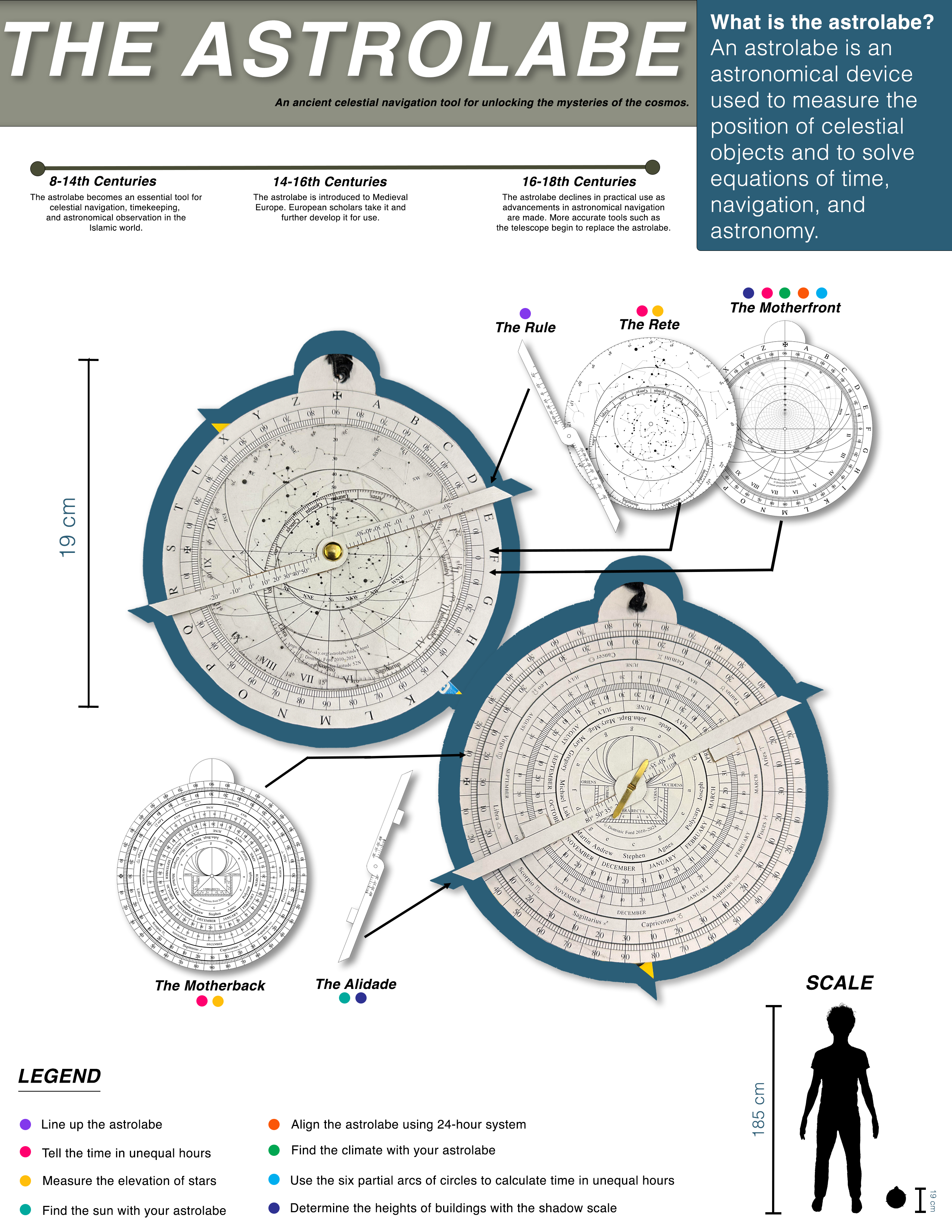
This poster breaks down the astrolabe into its five major components—the Rule, Rete, Motherfront, Motherback, and Alidade—and includes a historical timeline, labelled diagrams, and a functional legend. I used my own photographed astrolabe and created original vector artwork to illustrate each part, combining form and function on an articulated graphic surface.
The visual system prioritizes clarity through:
-
Color-coded legends
-
Scale comparisons (with human figure)
-
Callouts with technical terms and definitions
-
A modular layout with clear spatial hierarchy
User Guide Poster
Goal: Provide clear, visual step-by-step instructions for using an astrolabe.
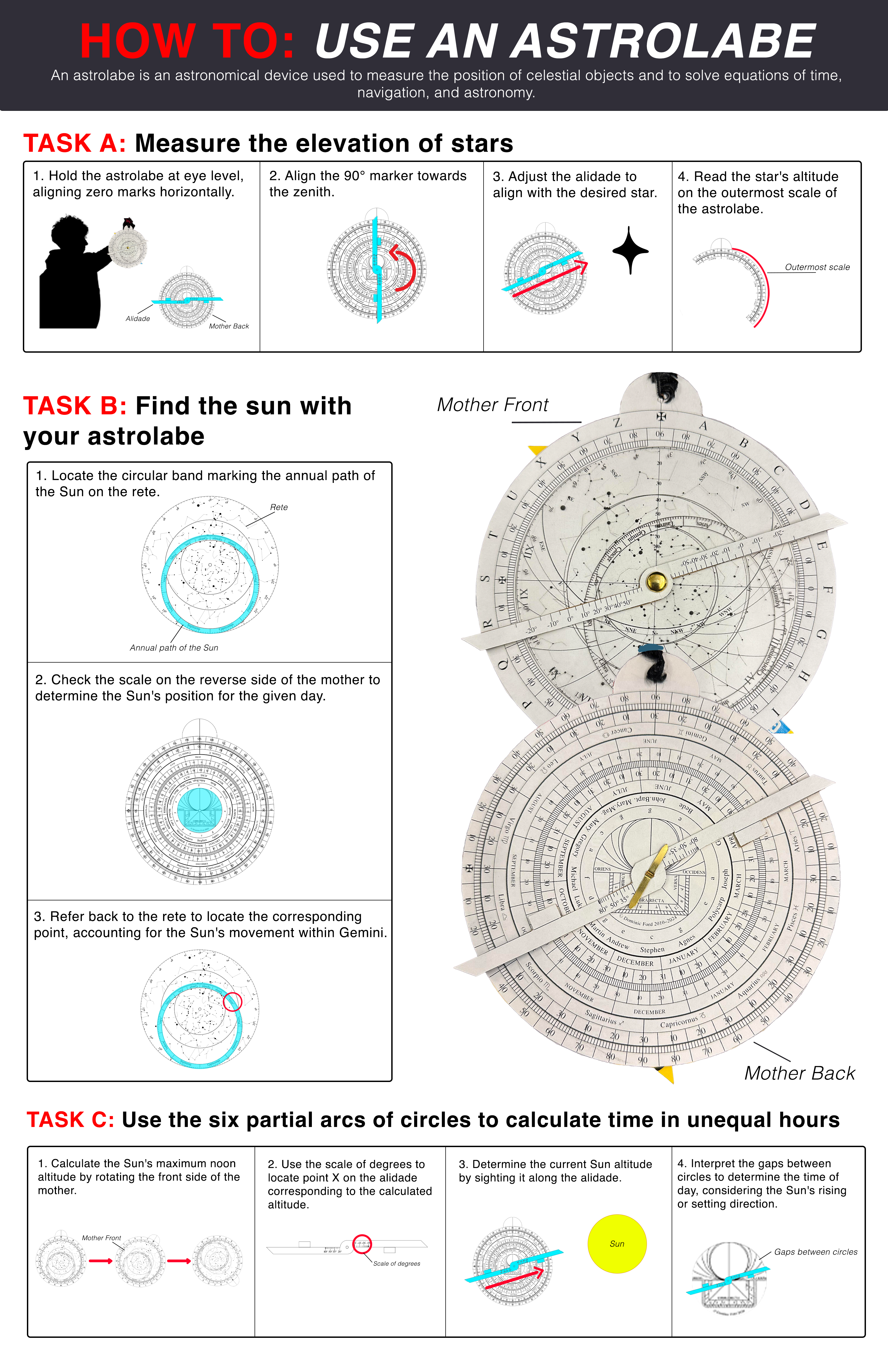
This instructional poster guides the user through three practical astronomical tasks:
-
Measuring the elevation of stars
-
Finding the Sun’s position
-
Calculating time using unequal hours
Each task includes:
-
Enumerated task steps
-
Visual “swimlanes” that align each step with an image for error-checking
-
Contextual explanations and supportive labels
-
A central image of the astrolabe with flipped front/back views
Results and Impact
Both posters met the criteria for professional, user-centered technical communication. The final work was praised for its clarity, elegant layout, and ability to make a complex historical device approachable for new users. By integrating visual consistency, scale cues, and accessible language, the system empowers users to meaningfully interact with the astrolabe without being overwhelmed by its complexity.
Final Thoughts
This project taught me how to balance visual storytelling with technical precision. I learned to analyze a system deeply through task analysis and program trees, and translate that understanding into two distinct communication modes—description and instruction. It also reinforced how vital user empathy and ethical language are when creating documents that support learning and curiosity.